Mahāsujava Jātaka
Mahāsujava Jātaka
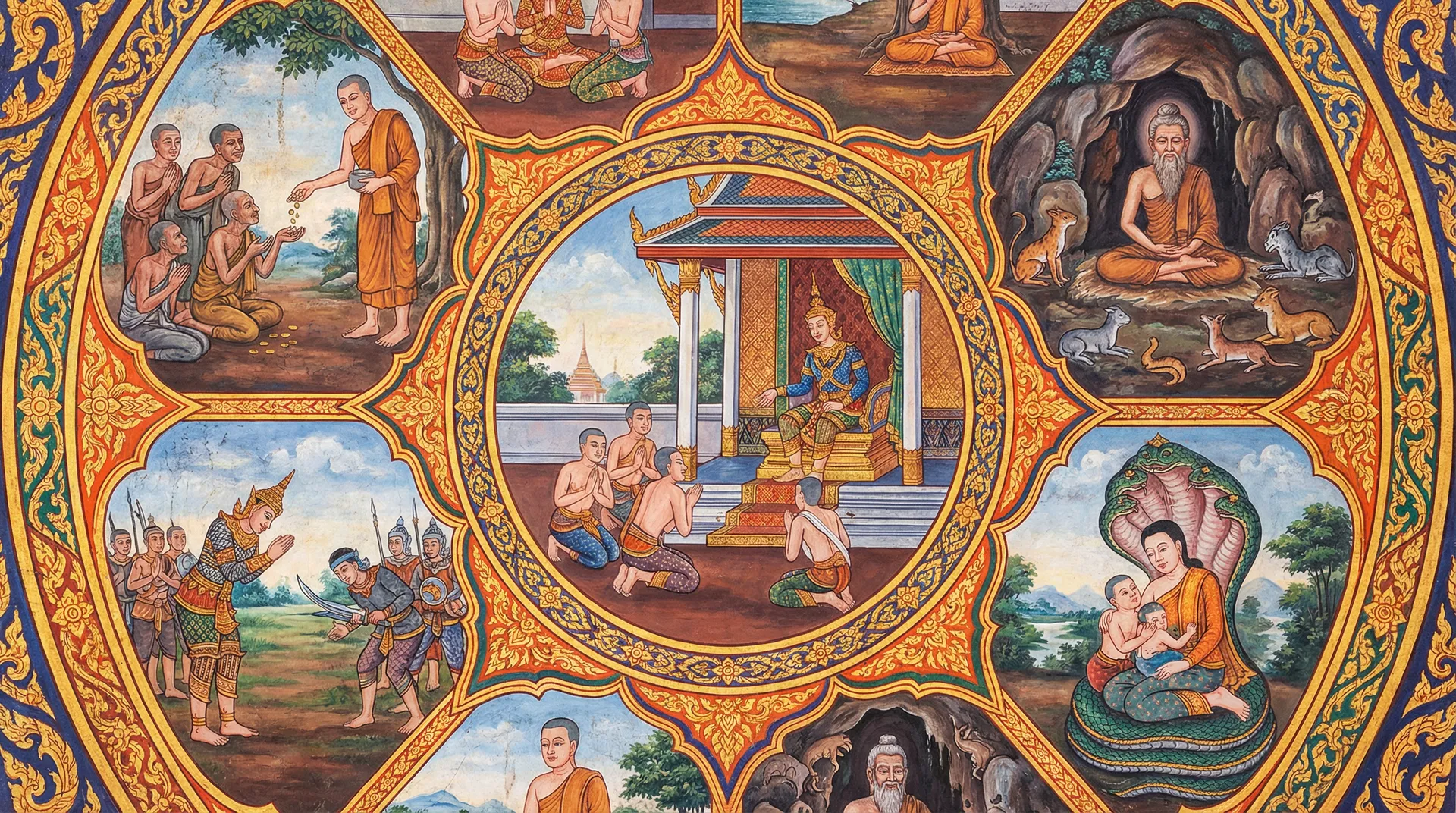
In a time long past, when gods and humans walked more closely, there flourished a great city renowned for its prosperity and the wisdom of its ruler, King Mahāsujava. This king was known far and wide for his unwavering commitment to justice and his profound understanding of the law. His reign was a golden age, characterized by peace, abundance, and the flourishing of arts and sciences. The king himself, in a previous life, was the Bodhisatta, a being of immense virtue and a future Buddha.
The Bodhisatta, as King Mahāsujava, was not only just but also incredibly generous. He believed that true leadership involved not just dispensing justice, but also ensuring the well-being of all his subjects, from the humblest farmer to the most learned scholar. His palace was a beacon of hospitality, and his treasury was always open to those in need. He had a particular fondness for the pursuit of knowledge and often engaged in deep philosophical discussions with the wisest minds of his time.
One day, a renowned scholar, a man who had dedicated his life to studying the ancient scriptures and the intricacies of the cosmos, arrived at the king's court. He carried with him a singular, extraordinary artifact – a jewel of unparalleled brilliance and beauty, said to possess the power to reveal hidden truths. The scholar explained that he had traveled for many years, facing numerous trials and tribulations, to present this jewel to the wisest and most virtuous king in the land. He believed that only King Mahāsujava possessed the discernment to truly appreciate its value and understand its potential.
The king, receiving the scholar with great honor, examined the jewel. It shimmered with an inner light, casting a rainbow of colors upon the walls of the throne room. As he held it, he felt a surge of clarity, as if the veil of illusion had been lifted from his mind. The scholar then spoke, "Your Majesty, this jewel is not merely a beautiful gem. It is a conduit to understanding. It reveals the true nature of things, the impermanence of all phenomena, and the interconnectedness of all beings. However, its power can only be fully realized by one who has cultivated great merit and wisdom."
The king was deeply impressed. He recognized the scholar's sincerity and the profound potential of the jewel. However, he also possessed an innate sense of caution and a deep understanding of the dangers of attachment. He knew that even the most beautiful things could become sources of delusion if not handled with wisdom.
Soon after, a great famine struck the land. The rains failed, the rivers dried up, and the crops withered. The people, once prosperous, now faced starvation. King Mahāsujava, heartbroken by the suffering of his subjects, immediately opened his granaries and treasury. He distributed food and resources generously, but the famine was severe and persistent. Despite his best efforts, the situation grew dire.
Witnessing the suffering, the Bodhisatta king remembered the jewel. He summoned the scholar and said, "My friend, you have brought me a treasure that reveals truth. Perhaps it can also reveal a way to alleviate this suffering. My people are perishing. I must find a solution."
The scholar, his heart heavy with the plight of the people, agreed. He instructed the king, "Your Majesty, the jewel's power is not in material wealth, but in illuminating the mind. To truly benefit from it, you must demonstrate your unwavering commitment to virtue. You must be willing to sacrifice even that which you hold most dear, for the greater good."
The king understood. He looked at the magnificent jewel, a symbol of ultimate wisdom and purity. He then looked at his people, their faces etched with hunger and despair. He made his decision. He declared to the scholar, "I will sacrifice this jewel. I will trade it for the lives of my people. If its true value lies in illuminating truth and goodness, then its greatest use will be to save my kingdom from this devastation."
The king then ordered that the jewel be displayed in the city square. He announced to his people, "This jewel is a symbol of the truths we hold dear – justice, compassion, and wisdom. I offer it in exchange for anything that can save us from this famine. I will trade it for seeds, for water, for any means to sustain your lives."
The news spread like wildfire. People came from all corners of the kingdom, bringing what little they had. Some offered precious heirlooms, others their meager savings. But the king's intention was not to acquire wealth, but to inspire action and unity. He used the resources gathered to organize massive irrigation projects, to procure seeds from distant lands, and to establish communal kitchens that fed the hungry. The jewel itself, placed on a pedestal, seemed to radiate an even greater light, as if in approval of the king's selfless act.
However, the famine was a formidable foe. The king knew that material solutions alone were not enough. He needed to address the root cause – the lack of rain. He recalled the scholar's words about the jewel revealing hidden truths. He decided to use the jewel not for trade, but for deeper contemplation.
He sat before the jewel, meditating deeply. He focused all his energy, all his prayers, and all his virtue on understanding the cause of the drought and finding a spiritual solution. He projected thoughts of immense compassion towards the suffering earth and its inhabitants. He acknowledged the impermanence of all things, including the current state of drought, and affirmed his faith in the eventual return of abundance.
As he meditated, the jewel pulsed with an extraordinary luminescence. The scholar, observing the king, felt a profound sense of awe. He saw that the king was not merely looking at the jewel, but communing with the very essence of truth it represented. Suddenly, the sky, which had been clear and relentless for months, began to darken. A gentle breeze stirred, carrying the scent of distant rain. Then, the heavens opened, and a torrential downpour washed over the parched land.
The people rejoiced, their prayers answered. The crops began to revive, the rivers filled, and life returned to the kingdom. King Mahāsujava, his heart overflowing with gratitude, understood that the jewel had not magically conjured the rain. Instead, his profound act of selflessness, his unwavering adherence to virtue, and his deep meditative connection with the essence of truth, had invoked the natural forces that brought forth the rain. The jewel had served as a catalyst, amplifying his virtuous intentions and his spiritual power.
The scholar, witnessing this miracle, bowed deeply to the king. "Your Majesty," he said, "you have proven that true wealth lies not in possessing such a jewel, but in the purity of your heart and the abundance of your merit. You have used this symbol of truth not for personal gain, but for the salvation of your people. You have shown that the greatest treasure is the cultivation of virtue and the selfless dedication to the well-being of others."
King Mahāsujava, ever humble, accepted the praise with grace. He continued to rule his kingdom with the same justice and compassion, ensuring that his people never again suffered such hardship. The jewel was kept in a place of honor, a reminder of the time when wisdom, virtue, and selfless sacrifice brought forth life from the brink of despair.
— In-Article Ad —
💡Moral of the Story
True wealth and power lie not in material possessions or brilliant artifacts, but in the purity of one's heart, the cultivation of virtue, and selfless dedication to the well-being of others. Profound acts of generosity and unwavering adherence to righteousness can invoke positive forces and bring about miraculous solutions.
Perfection: Generosity (Dāna Pāramī)
— Ad Space (728x90) —
More Jataka Tales You May Enjoy
 165Dukanipāta
Mahasattva Jataka
The Bodhisatta's Compassion for the Hungry TigressIn the vast, untamed wilderness of the Himalayas, ...
💡 The highest form of compassion is selfless sacrifice, willing to give one's own life for the well-being of others, even for animals, to alleviate suffering and demonstrate ultimate love.
 305Catukkanipāta
Sutasoma Jataka
Sutasoma JatakaIn the ancient and prosperous kingdom of Pancala, there lived a wise and benevolent k...
💡 True strength lies in compassion, wisdom, and the ability to transform others through understanding, rather than through force or violence. Non-violence and empathy can overcome even the most formidable adversaries.
 113Ekanipāta
Mahāgovinda Sutta Jātaka
Mahāgovinda Sutta Jātaka In the opulent city of Varanasi, a kingdom blessed with peace and prosperit...
💡 True wisdom lies in maintaining balance and equanimity in the face of both pleasure and adversity. Integrity and unwavering loyalty are the foundations of trust.
62EkanipātaThe Bodhisatta as the Grain-Seller's Son
The Bodhisatta as the Grain-Seller's Son In the ancient city of Savatthi, where the air hummed with...
💡 Observing moral precepts and vows leads to true happiness. Allowing desires to dominate will bring suffering.
7EkanipātaThe Steadfast Deer
The Steadfast DeerIn the serene and emerald expanse of a sacred grove, where ancient banyan trees sp...
💡 Unwavering steadfastness and a pure heart can overcome the direst of circumstances.
59EkanipātaThe Tale of the Kassapa City Maiden
In the prosperous realm of Kosala, in days long past, there lay a small city named Kassapa. This cit...
💡 True intentions are often revealed through actions, not words. Observe closely, for the subtlest signs can uncover the deepest truths.
— Multiplex Ad —